Chain slings and class 8 lifting chains
2026-10-14
Why class 8 is used for lifting
A class 8 lifting chain (T8, known abroad as G80) is a short-link calibrated chain of high-strength steel: at a moderate weight it carries a significantly greater load than a general-purpose chain of the same gauge. We manufacture it to TU 25.93.17-002-06515248-2026 for hoists, lifting and load-handling devices; by strength class it corresponds to the reference GOST EN 818-2-2017 (analogue of DIN 818-2 / EN 818-2).
It is important to distinguish the purpose: a chain sling and a lifting chain are not one and the same. Our T8 line is not a sling chain: as in GOST 30188-97, our TUs explicitly exclude its use as slings. Sling assemblies are a separate product with their own requirements, safety factor and documents.
How to read the loads of our TU-002
Our class 8 TU standardises three loads:
| Load | Example: 8×24-T8 |
|---|---|
| Acceptance proof, kN | 40.3 |
| Technological, kN | 48 |
| Breaking (BL), kN | 80.6 |
The working load (WLL) is not standardised in the TU. As a guide, the industry-wide approach is used: the working load is taken as BL/4 (safety factor 4) — a reference value outside the TU. More about the columns — in the article Chain load tables.
What a chain sling consists of
The basis of a cargo sling is a sling chain; the legs are connected by a link or ring, and the ends carry hooks or links for the specific task. Of hardware products we make rings, split pins and hooks, and T8 lifting chains — in the catalog.
When selecting, it is important to consider:
- The number of legs — single-leg and multi-leg slings work differently.
- The angle between the legs — the larger the angle, the higher the load on each leg.
- The centre of gravity and evenness — skewing loads one leg more than the others.
As for cargo slings and sling assemblies — this is a separate product with its own requirements: agree the task, safety factor and documents with a manager and a technologist.
Critical applications — separate requirements
For lifting people and critical load-handling operations, the application, safety factor and documents are regulated separately — agree them with a technologist and the occupational safety service.
This is not a formality: such operations require an agreed safety factor, formalised documentation and trained personnel.
Boundaries: what we supply
A separate catalog item — Galvanized chain sling — is a sling for a restraint system (safety harnesses) in work at height, not a cargo load-handling sling. Do not confuse these applications.
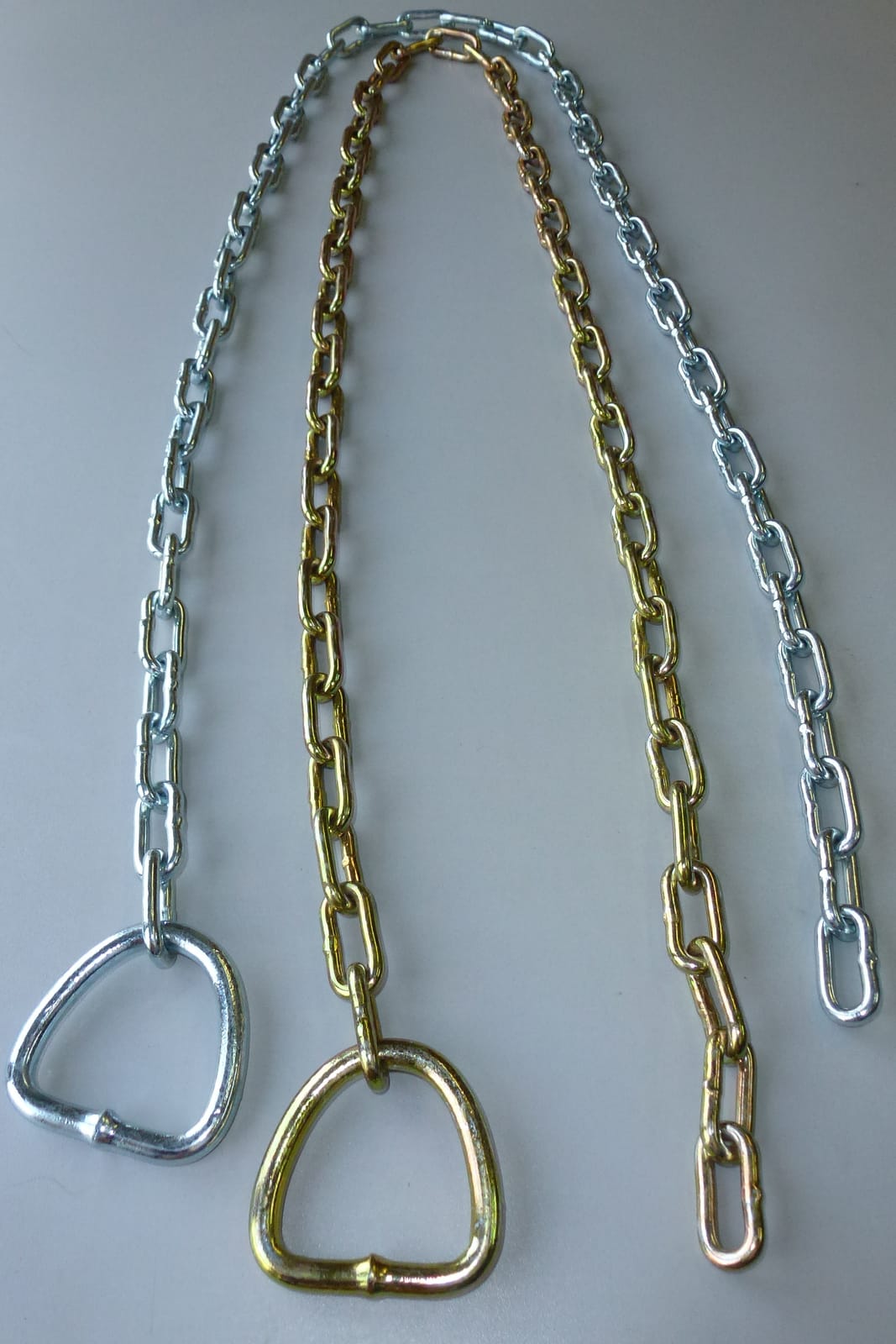
Galvanized chain sling — a product for a restraint system (two coating options shown)
Inspection and care
- Inspect the chains and sling elements before every use; at any defect — out of service (see Chain storage and inspection).
- The rejection criteria and inspection intervals for critical operations are established by your company's instructions.
- Accompanying documents for the batch — on request via a manager.
To select a lifting chain: selection by load or the industry page Construction and rigging.